Understanding Insomnia: From Pathophysiology to Diagnosis
27 Februari 2026
Description
Understanding Insomnia: From Pathophysiology to Diagnosis
Insomnia is one of the most commonly reported sleep disorders in clinical practice worldwide.1 It is a multifactorial condition, influenced by biological vulnerability, psychological processes, environmental factors, and learned behaviors.2 A clear understanding of how insomnia develops and how it is assessed allows healthcare providers to identify meaningful intervention points and plan individualized management strategies.
Mechanism of Insomnia Development
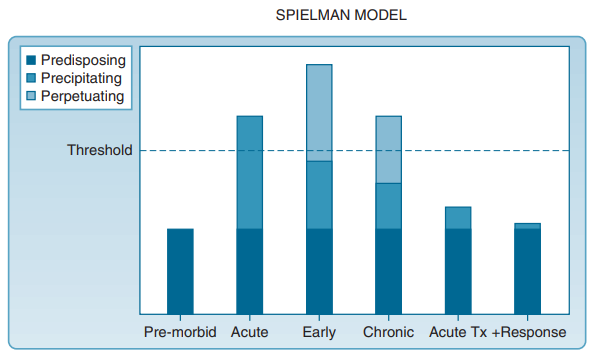
Insomnia arises from the interaction of pre-existing vulnerability, triggering events, and behaviors that maintain sleep disturbance over time.3 The Spielman 3P Model—Predisposing, Precipitating, and Perpetuating factors—is a widely used framework for describing the development and maintenance of insomnia.4 Figure 1 illustrates how these factors contribute across different phases of the disorder.
Figure 1. The Spielman 3P Model of Insomnia Development.This diagram illustrates the contribution of Predisposing, Precipitating, and Perpetuating factors across the natural history of insomnia.
Diagram explanation:
Pre-morbid: Baseline vulnerability (predisposing factors) exists before insomnia onset.
Acute: A precipitating event triggers initial sleep disruption.
Early: Both predisposing and precipitating factors drive early insomnia, with perpetuating behaviors beginning to appear.
Chronic: Perpetuating factors dominate, maintaining insomnia beyond the initial trigger.
Acute Treatment & Response: Effective treatment reduces perpetuating behaviors, lowering the combined 3P contribution below the clinical threshold.
The 3P model highlights how insomnia develops over time: predisposing factors create vulnerability, precipitating factors trigger sleep disruption, and perpetuating factors maintain it. Understanding each component clarifies why some sleep difficulties become chronic and guides targeted interventions.
Figure 2. Core Components of the 3P Model.
Predisposing Factors
Predisposing factors are long-term characteristics that increase susceptibility to insomnia. These factors are typically present before symptom onset and lower the threshold for sleep disruption:
Biological: Trait hyperarousal, including chronically elevated cortisol, increased metabolic rate, heightened startle response, or slow physiologic recovery after arousal.5
Psychological: Cognitive tendencies such as excessive worry or repetitive, intrusive thinking (rumination).6
Social: Persistent sleep/wake schedule conflicts, e.g., differing schedules with a bed partner or external demands such as childcare.
Predisposing factors do not cause insomnia on their own but increase sensitivity to sleep-disrupting events.
Precipitating Factors
Precipitating factors are acute events that trigger insomnia in a vulnerable individual. Common precipitating factors include:2,4
Once a precipitating event occurs, acute sleep disturbance often begins.
Perpetuating Factors
Perpetuating factors are behaviors and cognitive strategies adopted in response to sleep loss that inadvertently maintain insomnia, even after the initial trigger resolves.3 Two primary patterns are recognized:
Staying in bed while awake: Spending extended periods awake in bed weakens the association between the bed and sleep, conditioning arousal within the sleep environment. This mechanism is a core target of stimulus control therapy.7
Extension of sleep opportunity: Going to bed earlier, waking later, or both to “catch up” on sleep. This behavior often creates a mismatch between actual sleep ability and allotted sleep time, increasing nocturnal wakefulness. This principle underpins sleep restriction therapy, as emphasized in the Spielman model.4
Clinical Assessment of Insomnia
Insomnia is primarily a clinical diagnosis, supported by validated subjective and objective measures that quantify symptom severity, characterize sleep patterns, and guide treatment planning.1
A. Insomnia Severity Index (ISI)
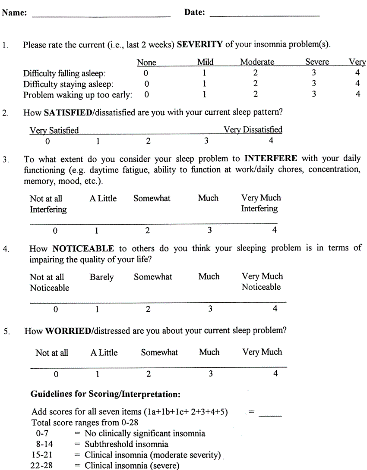
The ISI is a 7-item questionnaire assessing insomnia symptoms over the previous two weeks.8
Provides a broad view of sleep patterns, making it useful in patients with comorbid medical or psychiatric conditions.
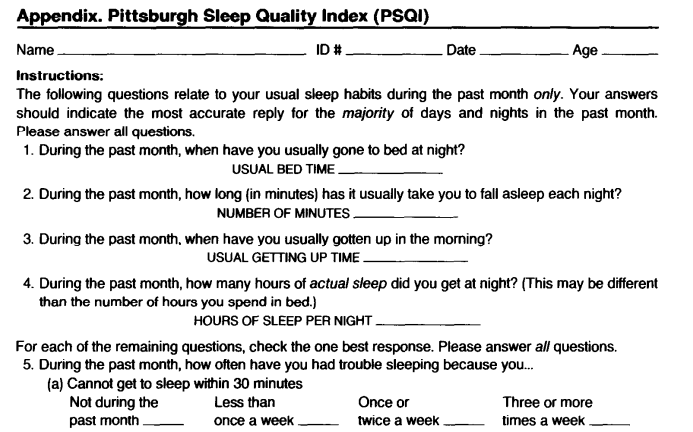
Figure 4. PSQI.This figure shows a cropped excerpt of the Pittsburgh Sleep Quality Index (PSQI) for illustrative purposes only. To view or reproduce the full questionnaire, please refer to the original publication.10
The PSQI complements symptoms-based measures and provides a broader view of sleep patterns.
C. Polysomnography (PSG)
Polysomnography (PSG) is an objective tool measuring sleep continuity, architecture (REM and non-REM), arousals, and other physiologic parameters.1
While insomnia is often diagnosed clinically, PSG is used to:
Evaluate atypical or treatment-resistant insomnia.
Support differentiation from other sleep disorders.11,12,13
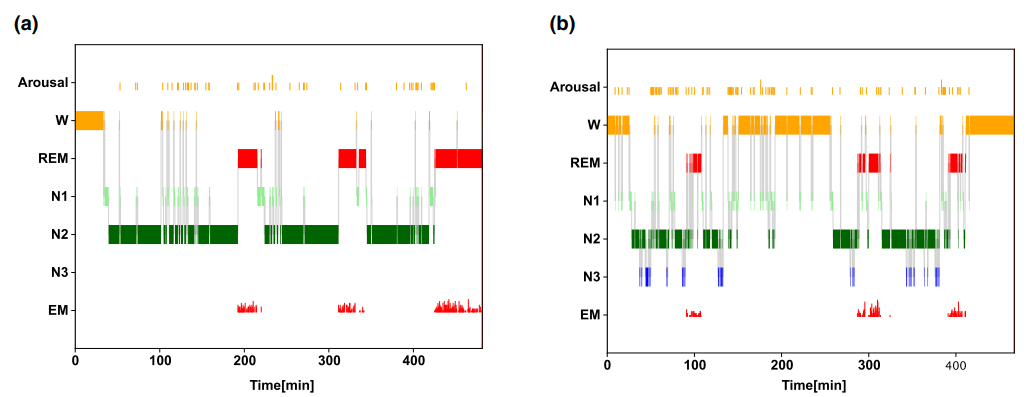
Figure 5. Polysomnographic Patterns in Insomnia: Normal (a) vs. Disturbed Sleep Continuity (b). 14
Diagram Explanation: (a) illustrates insomnia disorder without objective sleep continuity disturbance, showing generally preserved sleep efficiency despite subjective complaints. Minor findings such as slightly prolonged sleep onset or reduced N3 sleep may appear but are non‑specific. (b) illustrates insomnia disorder with objective sleep continuity disturbance, characterized by increased wake time after sleep onset and reduced total sleep time and sleep efficiency. These patterns highlight the variability of PSG findings in insomnia and the frequent mismatch between subjective and objective sleep reports.
PSG provides complementary physiologic insight, particularly when subjective measures are insufficient to fully characterize the patient’s sleep disturbance.
Summary
Insomnia develops through the interaction of predisposing vulnerabilities, precipitating stressors, and perpetuating behaviors. Clinical assessment combines structured patient interviews with validated instruments such as the ISI and PSQI. Objective measures, including PSG, may further characterize sleep continuity and architecture, supporting a comprehensive understanding of insomnia in selected patients and clinical contexts. Together, these approaches create a structured framework for diagnosis and management, enabling healthcare providers to deliver targeted, evidence-based interventions.
References
American Academy of Sleep Medicine. (2014). International classification of sleep disorders (3rd ed.). AASM.
Riemann, D., Spiegelhalder, K., Feige, B., Voderholzer, U., Berger, M., Perlis, M. L., & Nissen, C. (2010). The hyperarousal model of insomnia. Sleep Medicine Reviews, 14(1), 19–31.
Perlis, M. L., Smith, M. T., & Pigeon, W. R. (2017). Etiology and pathophysiology of insomnia. In M. Kryger, T. Roth, & W. Dement (Eds.), Principles and practice of sleep medicine (6th ed.). Elsevier.
Spielman, A. J., Caruso, L. S., & Glovinsky, P. B. (1987). A behavioral perspective on insomnia treatment. Psychiatric Clinics of North America, 10(4), 541–553.
Bonnet, M. H., & Arand, D. L. (2010). Hyperarousal and insomnia. Sleep Medicine Reviews, 14(1), 9–15.
Harvey, A. G. (2002). A cognitive model of insomnia. Behaviour Research and Therapy, 40(8), 869–893.
Bootzin, R. R. (1972). Stimulus control treatment for insomnia. Proceedings of the American Psychopathological Association, 7, 395–396.
Bastien, C. H., Vallières, A., & Morin, C. M. (2001). Validation of the Insomnia Severity Index. Sleep Medicine, 2(4), 297–307.
Morin, C. M., Belleville, G., Bélanger, L., & Ivers, H. (2011). The Insomnia Severity Index: Psychometric indicators to detect insomnia cases and evaluate treatment response. Sleep, 34(5), 601–608. [read.qxmd.com]
Buysse, D. J., Reynolds, C. F., III, Monk, T. H., Berman, S. R., & Kupfer, D. J. (1989). The Pittsburgh Sleep Quality Index: A new instrument for psychiatric practice and research. Psychiatry Research, 28(2), 193–213. https://doi.org/10.1016/0165-1781(89)90047-4 [scienceinsights.org]
Riemann, D., Baglioni, C., Bassetti, C., Bjorvatn, B., Dolenc-Groselj, L., Ellis, J. G., Espie, C. A., Garcia-Borreguero, D., Gjerstad, M., Gonçalves, M., Holzinger, B., Jardim, M., Jennum, P., Leger, D., Nissen, C., Parrino, L., Paunio, T., Pevernagie, D., ... Spiegelhalder, K. (2015). Objective sleep characteristics of insomnia disorder. The Lancet Psychiatry, 2(6), 547–558.
Perlis, M. L., Nissen, C., Spiegelhalder, K., & Riemann, D. (2011). Neurobiological mechanisms of chronic insomnia. Sleep Medicine Reviews, 15(5), 335–346.
Feige, B., Baglioni, C., Spiegelhalder, K., Hirscher, V., Nissen, C., & Riemann, D. (2013). The microstructure of sleep in primary insomnia. Sleep Medicine Reviews, 17(3), 155–164.
Frase, L., Nissen, C., Spiegelhalder, K., & Feige, B. (2023). The importance and limitations of polysomnography in insomnia disorder—A critical appraisal. Journal of Sleep Research, 32(6), e14036. https://doi.org/10.1111/jsr.14036